
How SMMAs Scale Without Hiring: AI Automation for Marketing Agencies
How SMMAs Scale Without Hiring: AI Automation for Marketing Agencies
SMMAs scale without hiring by automating the three tasks that eat account manager time: lead response and qualification, client onboarding, and monthly reporting. AI agents handle these processes instantly and consistently, which means an agency can add new clients without adding new payroll. This is what social media agency automation actually looks like in practice, not a vague promise, a specific shift in who (or what) does the repetitive work.
The hiring trap every SMMA hits
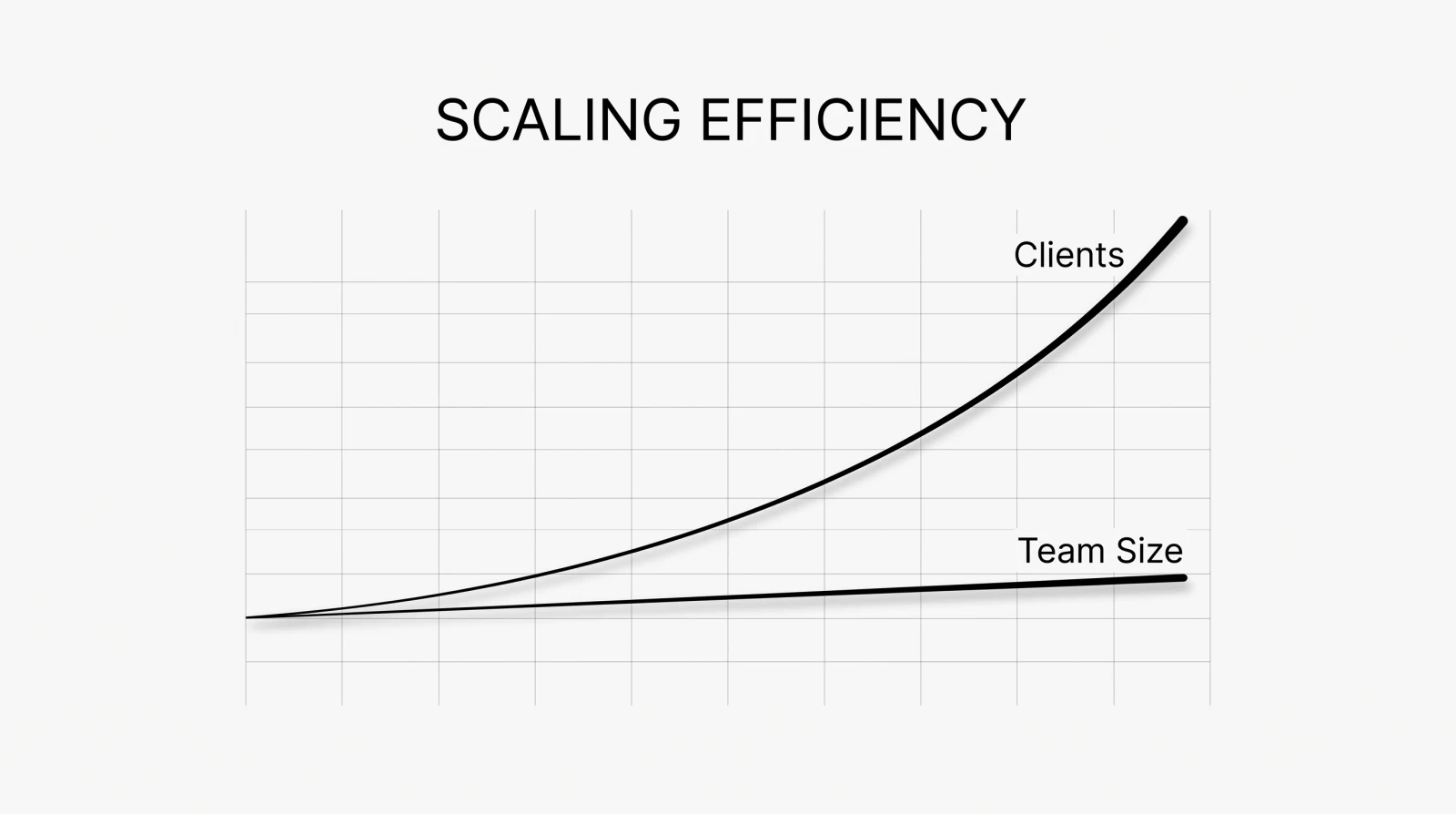
Every social media marketing agency runs into the same wall. You land more clients, so you need more account managers to service them. Each account manager needs training, oversight, and a manager of their own once you have enough of them. Margins shrink because payroll grows faster than revenue per client. And quality gets inconsistent, because no two account managers run onboarding or reporting exactly the same way.
This is the core problem with trying to scale a marketing agency without hiring: the business model ties growth directly to headcount. More clients has always meant more people. That link is what keeps agency owners working 60-hour weeks instead of building something that runs without them.
The fix isn't "work harder" or "hire smarter." It's removing the manual work that doesn't actually need a human doing it every single time.
Where the hours actually go
Ask any agency owner where their team's time goes and you'll hear a version of the same list:
- Responding to inbound leads from ads, DMs, and forms, often hours after the lead came in
- Qualifying prospects before a sales call, manually, every time
- Running onboarding calls, sending the same welcome emails, chasing the same intake forms
- Pulling data from ad platforms and analytics tools to build monthly client reports
- Formatting those reports and sending them out client by client
None of this is strategy. None of it is the reason clients hired the agency. It's overhead that scales linearly with client count, and it's exactly the kind of work AI agents are built to take over.
Why slow lead response is quietly killing your close rate
Here's a stat that should worry every agency owner: response speed to a new lead is one of the strongest predictors of whether that lead converts. If a prospect fills out a form or DMs your agency's Instagram at 9pm and doesn't hear back until the next afternoon, they've likely already messaged three other agencies. Agencies that respond in minutes close at meaningfully higher rates than agencies that respond in hours.
Manual lead response can't fix this. Your team sleeps, takes weekends, and has other work to do. An AI agent doesn't. It can respond to a new lead from Instagram, Facebook Ads, or your website form within seconds, ask qualifying questions (budget, industry, current marketing spend, timeline), and either book a call directly on your calendar or flag the lead as low-fit so your team isn't wasting time on it.
This alone changes the math on agency client acquisition. You're not generating more leads, you're closing more of the leads you already pay for.
Onboarding that doesn't depend on who's running it
Inconsistent onboarding is a silent tax on every SMMA. When onboarding lives in one account manager's head, quality varies client to client, new hires take months to get up to speed, and clients notice when their experience doesn't match what a previous client raved about.
Agency client onboarding automation fixes this by turning onboarding into a system instead of a person-dependent process. A well-built AI agent can:
- Send the welcome sequence and intake forms automatically the moment a contract is signed
- Follow up on missing information without a human having to chase it
- Schedule the kickoff call and send prep materials ahead of time
- Route collected assets (brand guidelines, login credentials, content calendars) to the right place automatically
- Notify the account manager only when a human decision is actually needed
The result is every client gets the same high-quality first impression, whether it's client number 3 or client number 300. That consistency is what makes an agency's growth handling this well look like agencies with far bigger internal teams.
Reporting: the hours nobody wants to spend but everybody has to
Monthly reporting is one of the most universally hated tasks in agency life. Pulling numbers from ad platforms, formatting them into something a client can understand, writing up commentary, and sending it out, client by client, month after month. For an agency running 20 or 30 clients, that's easily a full week of account manager time every single month. Time that isn't spent on strategy, upsells, or landing new business.
Agency reporting automation replaces this with a system that pulls performance data automatically, builds the report, and sends it on a schedule, no manual pulling, formatting, or sending required. Account managers still review and add strategic commentary where it matters, but the grunt work disappears.
That freed-up time is the real unlock. It's the difference between an account manager who spends their month firefighting admin and one who spends it finding upsell opportunities and keeping churn down.
What an AI agent actually does differently
To be concrete, here's the shift for a typical SMMA:
- Lead response: instead of a team member checking DMs and forms a few times a day, an AI agent responds instantly, qualifies the lead, and books the call, 24 hours a day
- Onboarding: instead of an account manager manually running each new client through the same steps, an automated sequence handles forms, scheduling, and follow-up consistently every time
- Reporting: instead of hours of manual data pulling and formatting each month, reports generate and send automatically, with account managers reviewing rather than building from scratch
- Account manager time: instead of being split between admin and strategy, it goes almost entirely to strategy, retention, and growing existing accounts
This is the practical meaning of scaling a marketing agency without hiring. The work still gets done. It just doesn't require a new person on payroll to do it.
How to think about the ROI
The math here isn't complicated, but it's worth doing on paper before you decide.
A full-time account manager, loaded with salary, benefits, software seats, and management overhead, typically costs an agency well into the five figures per year. That person can usually manage a limited book of clients before quality drops or they need help.
Compare that to the cost of automating lead response, onboarding, and reporting for your agency. Plans start at a fraction of one hire's monthly cost, and the capacity it buys doesn't cap out the way a single person's bandwidth does. An AI agent handling lead qualification and onboarding for 50 clients doesn't get slower or need overtime the way a human does at that volume.
The question isn't "AI agent or account manager." It's "what work should the account manager you already have be doing." Automation absorbs the repetitive layer so your existing team's time goes toward the client relationships and strategic work that actually require a human. That's usually enough additional capacity to take on new clients without a new hire at all.
Frequently asked questions
What is SMMA automation?
SMMA automation is the use of AI agents and automated workflows to handle repetitive agency tasks like lead response, client onboarding, and reporting, so the agency can grow client count without proportionally growing staff.
Can AI actually qualify leads for a marketing agency?
Yes. An AI agent can ask a prospect qualifying questions such as budget, industry, and current marketing spend, then either book a call for well-fit leads or flag poor-fit leads so a human never has to manually filter them.
Will automating onboarding make client experience feel impersonal?
No, if it's built right. Automation handles the repetitive steps, forms, scheduling, and follow-up, while account managers stay involved for the calls and decisions that need a human touch. Clients typically experience it as faster and more consistent, not colder.
How long does it take to set up agency automation like this?
A done-for-you AI automation system typically goes live in about two weeks, covering lead response, onboarding, and reporting workflows tailored to how the agency actually operates.
Is this only for large agencies?
No. Smaller agencies often benefit the most, since they don't have the budget to hire multiple account managers as they grow. Automation lets a lean team operate like a much bigger one.
How much does agency automation cost compared to hiring?
It varies by scope, but automation plans generally cost a fraction of one full-time account manager's salary per month, while adding capacity that scales without the overtime, training, or turnover risk that comes with a new hire.
See where your agency stands
If lead response, onboarding, or reporting is eating your team's week, that's capacity you could be putting toward new clients instead. Take the Automation Score to see exactly how much opportunity your agency is leaving on the table, or book a call to talk through what automating your agency's operations would actually look like.