
AI Automation for Real Estate Agencies: Never Miss a Lead Again
AI Automation for Real Estate Agencies: Never Miss a Lead Again
Real estate automation solves a simple, expensive problem: agents can't answer every call while they're showing property, and slow follow-up kills conversion. An AI agent answers and qualifies every call or text instantly, books the showing, logs it into your CRM, and keeps following up until the lead responds. Agencies that fix speed-to-lead close more deals from the same ad spend, without hiring another coordinator.
Why Real Estate Agencies Lose Leads Every Day
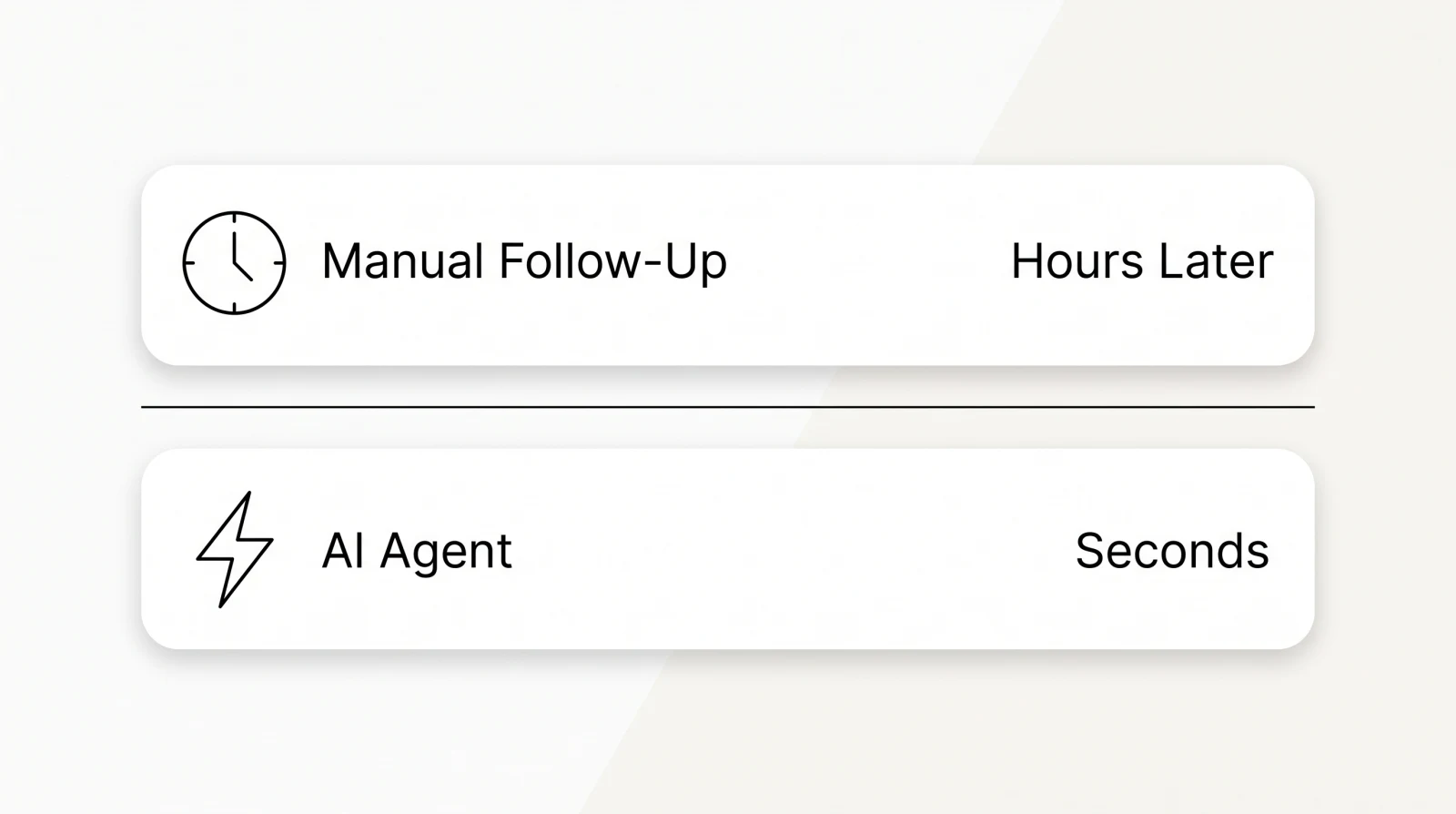
Speed to lead is the single biggest driver of conversion in real estate. Multiple industry studies over the years have landed on the same finding: contact a lead within five minutes and your odds of qualifying them jump dramatically compared to waiting even thirty minutes. Wait an hour and the odds fall off a cliff. Wait until the next morning and most agencies are just calling to confirm the lead already signed with someone else.
The problem is structural, not a discipline problem. Your best agents generate leads specifically by being out of the office: showing homes, sitting open houses, running closings. That is the job. But it also means the phone rings and nobody picks up. A text comes in from a Zillow lead at 8:47pm on a Saturday and it sits until Monday. A buyer fills out a contact form on your website at 11pm and gets an auto-reply that nobody actually reads for twelve hours.
None of this is because your team is lazy. It's because a human being cannot be in a showing and on the phone at the same time, and cannot work nights and weekends indefinitely. Missed calls in real estate aren't an execution failure, they're a coverage gap.
The Real Cost of a Missed Call in Real Estate
Every missed call or ignored text is a lead you already paid for. If you're running Zillow, Realtor.com, or paid social ads, you spent real money to get that person to raise their hand. When nobody answers, you didn't just lose a conversation, you lost the acquisition cost too, and that lead is now one call away from a competing agent who did pick up.
Stack this across a month and the math gets uncomfortable fast. An agency generating 150 inbound leads a month that misses or slow-responds to even a third of them is effectively throwing away 50 opportunities. At typical real estate close rates and commission values, that is not a rounding error, it's the difference between a good quarter and a mediocre one.
Weekends and evenings are the worst blind spot. That's when buyers actually have time to browse listings and fill out forms, and it's exactly when most brokerages have the thinnest coverage. If your only plan for after-hours leads is "we'll call them Monday," you're voluntarily handing warm leads to whoever answers first.
What Real Estate Automation Actually Looks Like
This is where an AI lead follow up system for real estate changes the equation. Instead of a lead sitting in a voicemail box or a "new lead" CRM column, it gets handled the moment it comes in, 24 hours a day.
Instant call and text response
A real estate AI agent picks up the phone or replies to the text within seconds, not hours. It sounds natural, answers basic questions about the listing, and doesn't put anyone on hold. For a buyer or seller comparing agencies, being the one who actually responds immediately is often the whole decision.
Qualifying and booking showings automatically
The agent asks the questions your ISA or front-desk person would ask: budget, timeline, financing status, preferred areas, whether they're pre-approved. It scores the lead on the spot and, for a qualified prospect, books a showing or a call directly onto the right agent's calendar, no back-and-forth required.
Automatic CRM logging
Every call, text, and booking gets logged into your real estate CRM automatically: contact details, conversation summary, lead score, next steps. No agent has to remember to type up notes after a showing or update a pipeline stage from memory at 9pm. Real estate CRM automation like this means your data is actually current, which matters when you're forecasting pipeline or auditing which lead sources perform.
Scheduled follow-up for old and cold leads
Most agencies have a graveyard of leads from six, twelve, eighteen months ago who never bought or sold but also never said no. An AI agent can work that list on a set cadence: a text here, a call there, checking back in without anyone on your team having to remember to do it. Some of those cold leads are just waiting for a nudge at the right moment.
Real Estate CRM Automation: Connecting the Dots
The pattern that hurts agencies most isn't a missing tool, it's disconnected tools. A call comes into one system, the lead gets typed into the CRM manually (if at all), a follow-up task gets created in a spreadsheet, and a text goes out from a completely different app. Every handoff between systems is a place a lead falls through.
Real estate automation done right connects these steps so nothing depends on a human remembering to do the next thing. The call or text triggers qualification, qualification triggers a CRM entry, the CRM entry triggers a follow-up sequence, and a booked showing triggers a calendar invite and a reminder text to the buyer. One event, one continuous chain, no manual re-entry.
This matters more as an agency grows. A two-agent shop can sometimes get away with sticky notes and good memory. A twenty-agent brokerage cannot. The bigger the lead volume, the more expensive every manual step becomes, and the more a missed handoff costs.
How to Think About ROI
The ROI math for automation in real estate is unusually forgiving because the value of a single closed deal is so high relative to the monthly cost of running an AI agent. Plans for done-for-you automation typically start in the range of a junior part-time hire's monthly cost, and a single additional closing, at almost any commission split, covers months of that investment on its own.
Run the numbers for your own agency:
- Estimate how many leads you currently miss or respond to too slowly each month.
- Apply your normal lead-to-close rate to that number.
- Multiply by your average commission per deal.
- Compare that recovered revenue to the monthly cost of automating call, text, and follow-up handling.
For most agencies, recovering even two or three additional closings a year from leads that were previously falling through the cracks pays for the system many times over, and that's before counting the hours of manual data entry and phone tag it eliminates for your team.
Getting Started Without Disrupting Your Team
You don't need to rip out your existing CRM or retrain your whole team to get started. A well-built system plugs into what you already use, handles the answering, qualifying, and logging in the background, and hands off a warm, booked appointment to your agents. Most implementations go live in about two weeks, so you're not looking at a quarter-long rollout to see results.
The agents you already have stay focused on what they're best at: showing homes, negotiating, closing. The automation handles everything that happens before a human needs to be involved, and everything that happens after a lead goes cold and needs a nudge.
If you want a clear picture of what this is worth for your specific agency, take the Automation Score. It takes a few minutes and gives you a free, personalized report on how many leads and hours you're currently leaving on the table. You can also look at our AI agents built specifically for real estate workflows, or see pricing to understand what a system like this costs to run.
Frequently asked questions
How fast does an AI agent respond to a new real estate lead?
Typically within seconds of the call, text, or web form submission, day or night. That's the entire point: eliminating the gap between a lead raising their hand and someone actually talking to them.
Will an AI agent replace my agents or ISA?
No. It handles the always-on answering, qualifying, and logging work so your agents and ISA spend their time on showings, negotiations, and closings instead of chasing missed calls and data entry.
Does this work with the real estate CRM I already use?
Most modern CRMs support this kind of integration. The automation connects to your existing CRM and updates it directly, so your team keeps working out of the same system they already know.
What happens to leads that come in after hours or on weekends?
They get answered and qualified immediately, the same as during business hours. This is usually where agencies see the biggest lift, since after-hours and weekend leads are the ones most often lost today.
How long does it take to get a real estate AI agent live?
Most systems go live in about two weeks, including setup, CRM connection, and testing against real call and text scenarios before it goes fully live.
Is this worth it for a small agency or solo agent?
Often yes, since the cost of missing even one deal a quarter usually exceeds the monthly cost of automating. The Automation Score quiz gives a personalized read on whether it makes sense for your specific lead volume and team size.
Stop losing deals to a slow callback. Take the Automation Score to see exactly how many leads and hours your agency is leaving on the table, or book a call to talk through what a real estate AI agent would look like for your team.