
AI Agents vs Chatbots: What Is the Real Difference
AI Agents vs Chatbots: What Is the Real Difference
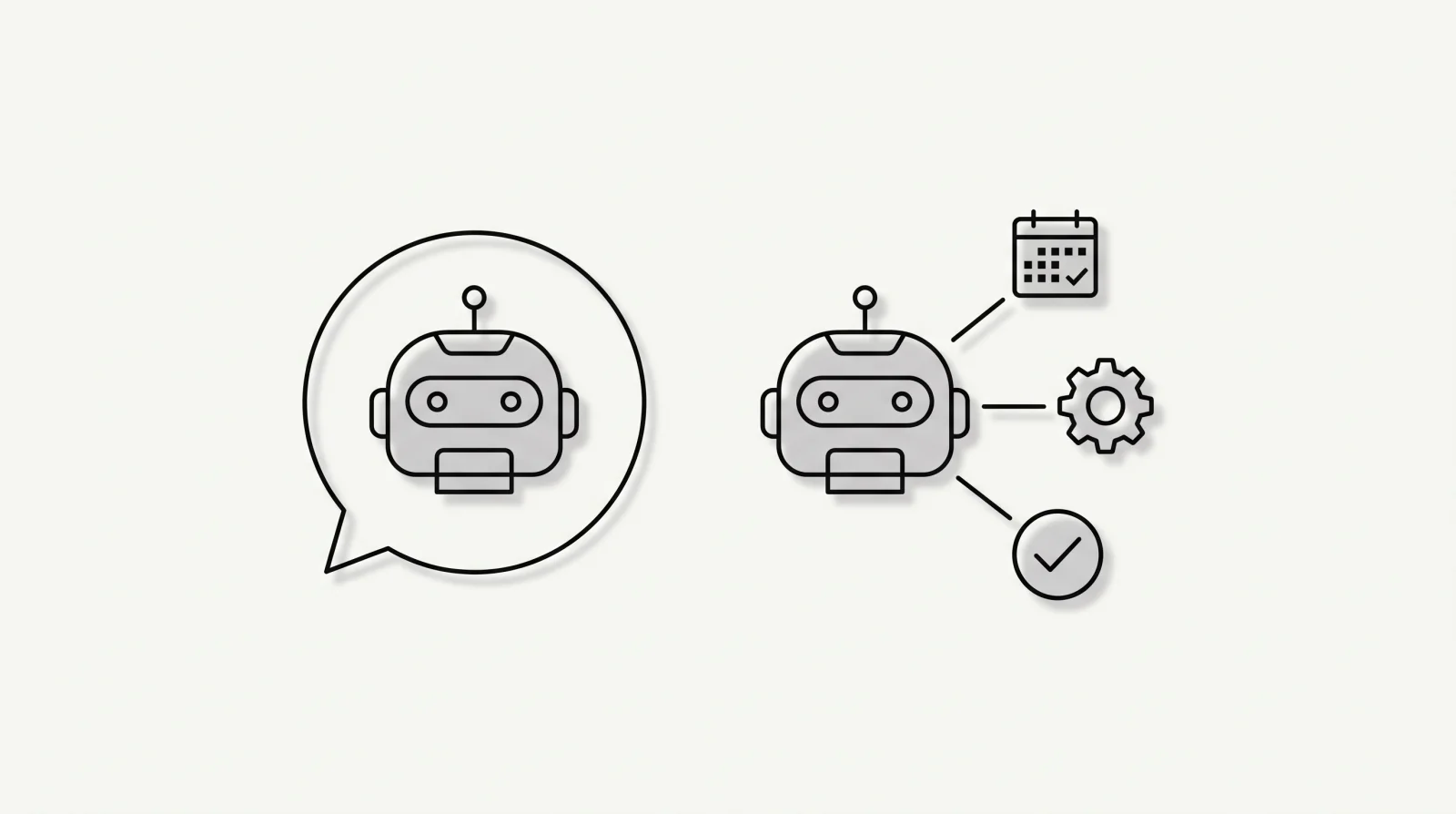
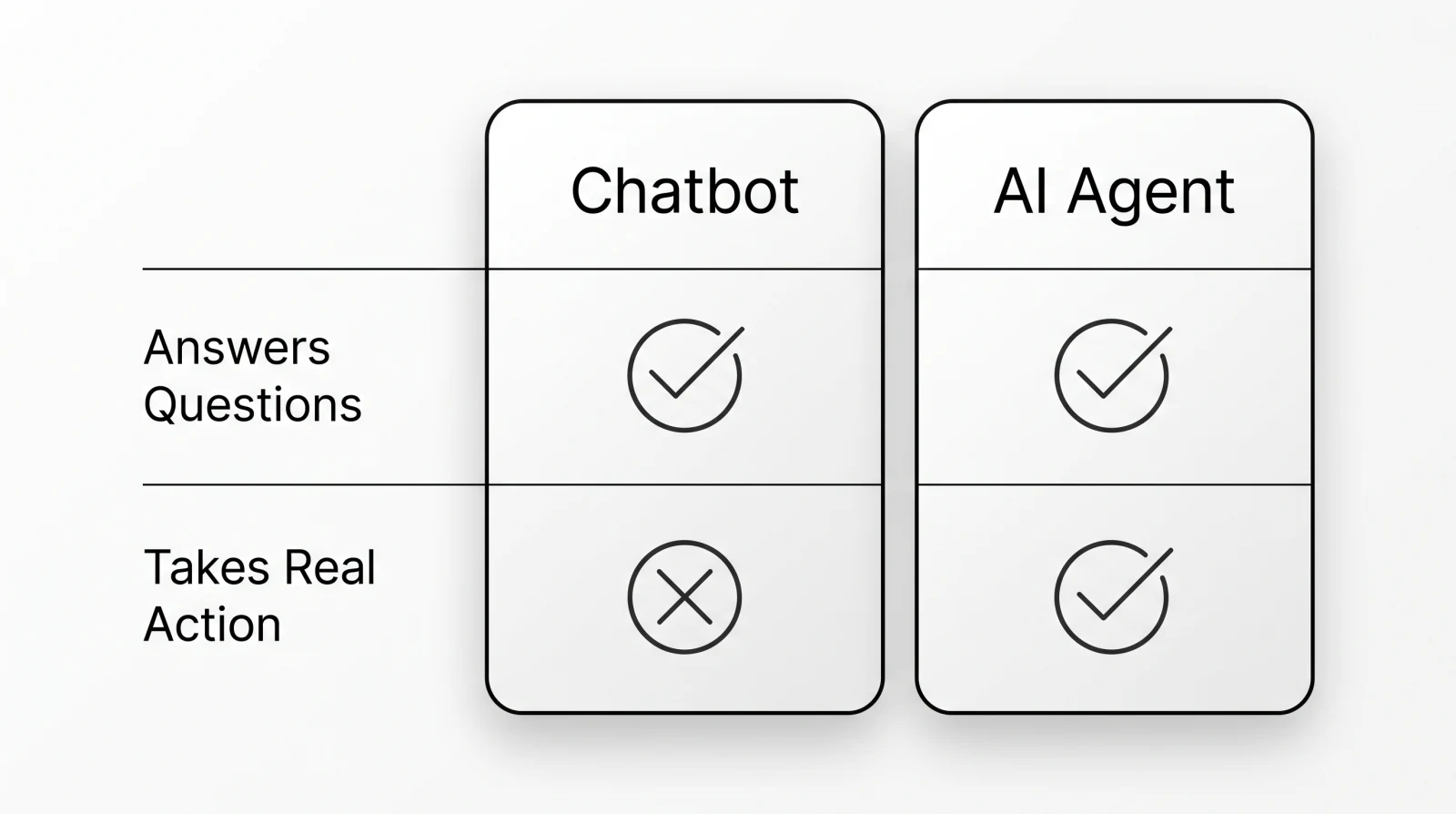
A chatbot follows a scripted decision tree or matches keywords to pre-written answers, and it cannot do anything outside the chat window. An AI agent uses a language model to understand open-ended requests, decide what needs to happen, and actually execute multi-step actions in your real business systems, like checking a calendar, booking an appointment, updating a CRM record, or sending a follow-up text. That distinction, answering versus acting, is the entire difference between AI agents vs chatbots, no matter how the marketing around either one is worded.
Most vendors use "AI agent" and "chatbot" interchangeably because both terms sound like automation and both can live inside a chat widget. But under the hood they are built differently, they cost differently to run, and they solve different problems. If you are evaluating tools for your business, this is the one distinction worth actually understanding before you sign a contract.
What is an AI agent, really
An AI agent is software built on a large language model that can interpret a request in plain language, reason through what steps are needed to fulfill it, and carry out those steps by connecting to other systems, calendars, CRMs, phone and text platforms, databases, internal tools. It does not just respond. It acts, then confirms the action happened.
Say a lead texts "can I come in Thursday afternoon instead of Tuesday." A chatbot sees this as an unmatched pattern and either fails silently or hands off to a human. An AI agent parses the intent, checks the real calendar for Thursday afternoon openings, reschedules the existing booking, updates the CRM record, and texts back a confirmation, all without a person touching it. That is the practical gap between AI agents vs chatbots for business use: one produces text, the other produces outcomes.
What is a chatbot, really
A traditional chatbot operates on scripted logic: decision trees, button menus, or keyword and pattern matching against a set of pre-written FAQ answers. Ask it something inside its script and it performs well. Ask it something slightly off-script, a rescheduling request, a multi-part question, anything requiring judgment, and it either loops, gives a generic non-answer, or routes to a human. Some newer "AI chatbots" use a language model to sound more natural in conversation, but if the underlying tool still cannot check a live calendar, write to a CRM, or complete a transaction, it is still fundamentally a chatbot: a smarter front end with no hands.
AI agents vs chatbots: a direct comparison
Here is the difference between chatbot and AI agent broken down across the dimensions that actually matter to a business owner.
What triggers them
- Chatbot: a typed message that matches a known pattern, keyword, or menu option.
- AI agent: any natural-language request, phone call, text, DM, or form submission, interpreted for intent rather than matched to a script.
What they can do
- Chatbot: answer pre-written questions, point to a help article, collect basic info, or hand off to a human.
- AI agent: answer questions and take action, book or reschedule appointments, qualify and route leads, update records, send follow-ups, generate reports.
Access to live business systems
- Chatbot: usually none. It lives inside its own chat window and does not read or write to your calendar, CRM, or phone system.
- AI agent: connects directly to those systems, so a booking it makes is a real booking, not a message someone still has to act on manually.
Handling multi-step tasks
- Chatbot: struggles or fails once a request requires more than one decision in sequence, like checking availability, confirming a time, and logging the result.
- AI agent: designed for exactly this, it can chain several actions together in one interaction without a human stitching the steps together afterward.
What happens off-script
- Chatbot: dead end. It repeats itself, gives an unrelated answer, or dumps the conversation on a human with no context.
- AI agent: reasons about the request even if it has not seen that exact phrasing before, and if it hits something outside its authority, like a refund above a set amount or a legal question, it escalates to a human with full context attached instead of just bailing out.
Is a chatbot an AI agent
Not by itself. A chatbot can be one small piece inside an AI agent's system, the part that receives a message, but a chatbot alone is a fixed script with no reasoning and no ability to act. An AI agent is a broader system: language understanding plus the ability to execute real steps in connected tools. Every AI agent can hold a conversation. Very few chatbots can independently book a job, update a record, or resolve a request end to end.
Do you actually need an AI agent
Honestly, not always. If your business genuinely just needs to answer the same five questions over and over, hours, location, pricing tiers, a well-built FAQ chatbot is cheap, fast to set up, and does the job. Buying a full AI agent for that is overkill.
The real question to ask is not "chatbot or AI agent," it is: does this task require taking action inside your business systems, or does it only require answering a question? If a missed call needs to become a booked appointment on your actual calendar, if a lead needs to be qualified and routed to the right person, if a customer needs their account updated, that requires action, and a chatbot cannot deliver it no matter how well it is written. That is where an AI agent earns its cost.
This is also usually where the real money is being lost. Missed calls that never get called back. Leads that go cold because follow-up happens two days late instead of two minutes late. Manual data entry eating hours every week that should be spent on the business, not the busywork.
How to tell what you're actually being sold
Ask any vendor pitching you an "AI agent" three questions. Can it check my real calendar and book on it, not just suggest a time. Can it write back to my CRM. What does it do when a conversation goes somewhere it wasn't scripted for. If the answers are vague, or the tool can only produce a summary for a human to act on, you are looking at a chatbot with an AI-sounding name, not an agent. Our AI agents are built specifically to pass all three of those tests before they go live for a client, and you can read more on why AI agents matter for businesses that are done losing leads to slow response times.
Where most businesses actually stand
Most small and mid-size businesses we talk to are not asking "which chatbot vendor," they are asking "how much manual work can actually come off my plate." That answer depends on your call volume, your team size, your current tools, and how many hours a week your staff spends on things a system could do instead. Guessing at that number is where most owners get stuck.
That is exactly what the Automation Score is for. It is a free, personalized report: answer a few questions about your industry, team size, pain points, and how you currently handle missed calls and follow-ups, and it scores how much opportunity, in lost revenue and wasted hours, you are leaving on the table by not automating. The more pain points and manual hours you're carrying, the higher the score, and the more upside there is in fixing it.
Frequently asked questions
Is a chatbot an AI agent?
No. A chatbot is a scripted or pattern-matching tool that answers questions inside a chat window. An AI agent uses a language model to understand requests and take real action in connected systems like a calendar or CRM. A chatbot can be a component of an AI agent, but on its own it is not one.
Do I need an AI agent or is a chatbot enough for my business?
If your customers only need answers to a small, predictable set of questions, a chatbot is enough and costs less. If tasks need to result in an actual booking, an updated record, or a completed follow-up, you need an AI agent, because a chatbot cannot take that action.
What is an AI agent in simple terms?
It is software that reads or hears a request in plain language, figures out what needs to happen, and does it inside your actual business tools, rather than just replying with text a person still has to act on.
Can an AI agent replace my front desk or phone answering?
Yes, for the tasks that are rule-based and repetitive: answering common questions, checking availability, booking or rescheduling, and collecting the right information before a human ever needs to step in. Complex judgment calls still route to your team.
What happens when an AI agent doesn't know the answer?
A well-built AI agent recognizes when a request is outside what it should handle and escalates to a human with the full conversation context attached, instead of leaving the customer stuck or guessing.
How long does it take to set up an AI agent for a business?
At Bez Builder, most AI agent systems go live in about two weeks, built around your existing calendar, CRM, and phone or text setup rather than requiring you to switch tools.
Where to go from here
If you're not sure whether your business needs a simple FAQ chatbot or a full AI agent that can act on your calendar and CRM, don't guess. Take the Automation Score and get a free, personalized breakdown of where you're losing revenue and hours to manual work, or book a call to talk through what an AI agent would actually look like for your business. You can also see pricing or contact us with questions.